How We Can Protect Nature in Our Community
For a habitable planet, revival will require us to adopt responsible practices in our own lives and fight for system level change
NEWSNATUREAGRICULTUREGARDENINGCULTUREFOOD JUSTICEMYCOLOGY
James Davis
4/18/20264 min read


Revival requires responsibility.
No man or miracle is going to protect us from the myriad of threats we face from industrial pollution in our food, air, and water. All we can do is adopt simple yet profound practices that can inspires others and shift our culture over time. And have fun doing it.
Our mission at Bay Staters for Creative Well-Being is to bring people together to learn how our own health is inextricably linked to the fate of every other person, animal, fungi, and plant that shares this impossible experiment called Earth.
In this article, we lay out some simple ways to make change and make an impact in the lives of thousands of critters who share your neighborhood (and improve your own life in so doing).
Foraging for and growing your own food
Eating a handful of mushrooms a day can reduce your risk of cancer and heart disease by nearly 45%, according to a meta-analysis of studies published in the Journal of Advanced Nutrition. This is because mushrooms are effectively a cholesterol-free meat that are high in fiber and beta-glucans that nourish our gut bacteria. It’s easy to get started foraging, and this article describes the basics and a few local species to look for.
Moreover, mushrooms want you to eat their flesh, making them a wonderfully ethical and sustainable food source. The actual organism that fruits them, known as mycelium, uses your foraging habits to spread their spores and reproduce in nature. Moreover, foraging mushrooms is completely sustainable for all but the most ruthless of commercial vendors. A 27-year study of foraging found no adverse impacts to removing species from ecosystems for personal use.
Additionally, integrating more plants into your diet and going through the physical exercise of retrieving them from your yard or a local market are cornerstone of what help people live long, healthy lives. In communities around the world known as blue zones, such as Okinawa and Seventh Day Adventist communities in the United States, plants are the main staples of the diets that sustain the population to live long past the age of 80 (see this excellent Netflix Documentary here). The biomarkers of people who eat mostly plants are also beneficial for heart health, mental health, sexual health, and energy levels, as “You Are What You Eat” on Netflix explains by challenging twins to adopt healthful diets through an experiment at Stanford University.
To learn more, we encourage you to join one of our community mushrooms walks or gardening events. At these events, we bring people together to mentor each other and inspire ourselves to live more in tune with nature. Remember to never eat any mushroom unless you are 100% sure of its identity and that you can always reach out to us ([email protected]) for help. Make sure not to leave mushrooms out unrefrigerated overnight or in a hot car for more than a couple of hours because it can lead to bacteria build-up.
Leave your Leaves
Leaves are not a blemish. Their trillions of brilliant colors, reflected as a vibrant brown, is the result of 400 million years of evolutionary biology. Trees carefully calibrate and individually chose when to drop their leaves each season to conserve energy, and the nutrients create a rich mulch that nourishes all the other plants in your yard.
Over the winter, bugs and bees in particular lay their larvae underneath leaves. And bugs are good, contrary to what some of us have been force fed by our culture. Yes, they can be annoying. But they pollinate many of our plants that we rely on to survive, and they are food for the birds that give us the natural soundtrack of the woods. Alarmingly, bug levels
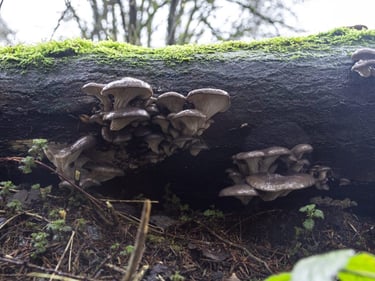
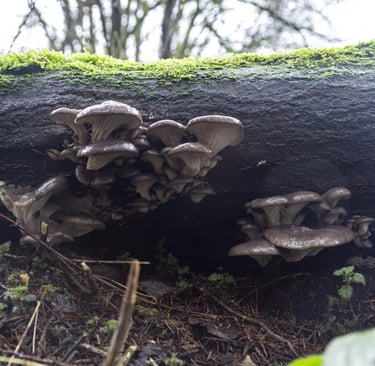
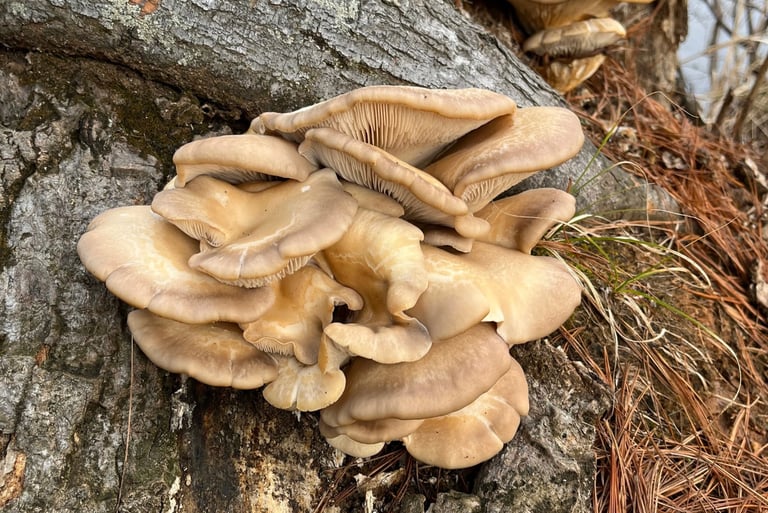
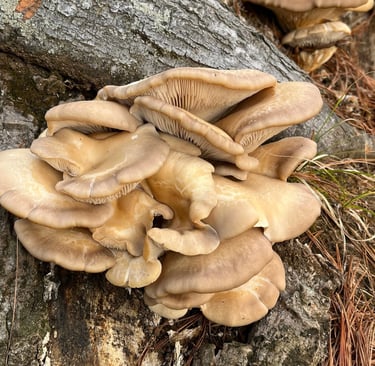
Turkey Tail
Found year-round on dead logs and stumps, turkey tail mushrooms are a common “adaptogenic” mushroom that is put in fancy mushroom coffees. To make your own tea that can promote better immune system health, simply pluck them and boil them in water continuously for 45 minutes or more. This continuous boiling is important so that the nutrients in the mushrooms actually leave the cell walls. This process can be repeated for other mushroom varieties, such as chaga.
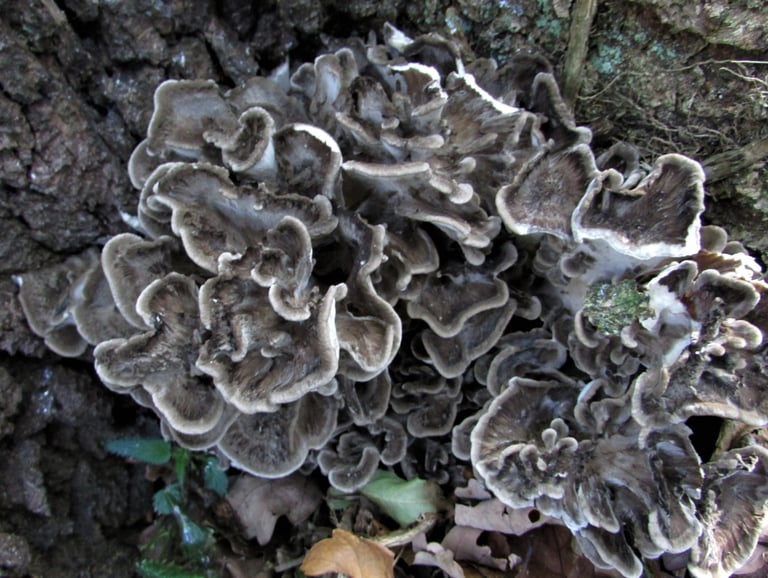
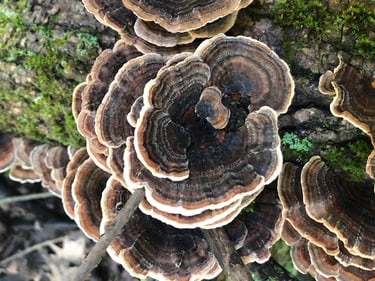
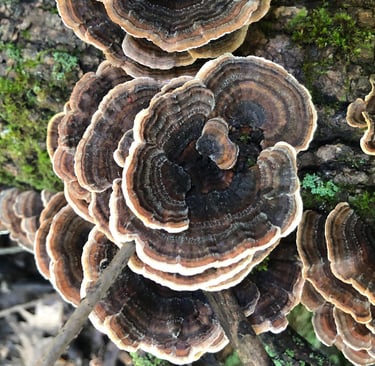
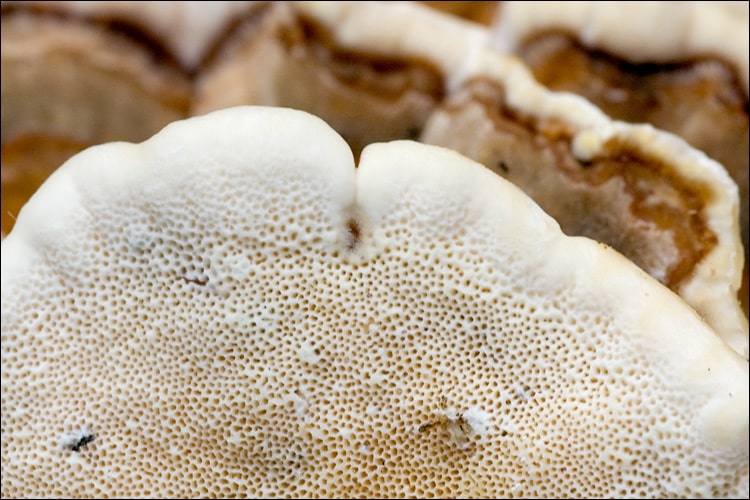
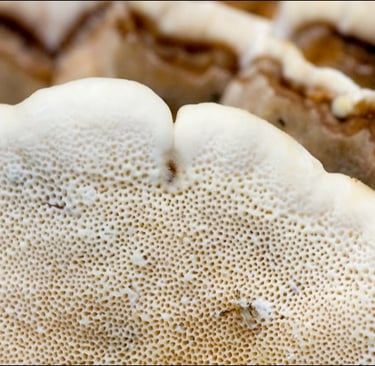
Turkey tail can come in a huge number of colors and patterns (see below for just one example), from oranges to blues to reds to browns. There are also mushrooms called “false turkey tail” and violet-tooth that have similar patterns. While these species are harmless for you to boil into tea, true turkey tail mushrooms have pores (see below) underneath their cap vs. spines (as in the case of violet tooth) or a flat surface (in the case of false turkey tail).
Protect Our Soil
Soil is effectively a living organism itself with rocks and sand as its skeleton, decaying leaves and plant material as its flesh, and the roots of plants and mushrooms (ie. mycelium) as its nervous system. In a single cubic inch of soil, there are more species than all of the plant and vertebrate animals in North America.
This article is in the process of being updated for the launch of our regenerative zine series. It should be done by the end of the day on April 20th.
Bay Staters for Creative Well-Being
Building healthful community through creative art and nature education
© 2026. All rights reserved. Bay Staters Incorporated, 501(c)3