What is the Future of Psychedelic Policy?
Reflections from Advocates on What Comes Next for Mushrooms
DRUG POLICYDECRIMINALIZATIONPSYCHEDELICSNEWS
The Bay Staters Team
3/20/20263 min read
We love plant medicines.
From our creation, our volunteers have bravely shared their stories of how psilocybin mushrooms have been transformational for our struggles with finding purpose in life, recovering from trauma, finding relief from addictions, and abating painful neurological conditions like Lyme and cluster headaches.
It was these stories that inspired us to reach out to Somerville's City Council in 2020, slowly but surely building the local policy and consensus that would lead the city to become the first east of the Mississippi to end arrests for adults growing and share mushrooms. And the first city in North America, to our knowledge, that affirmed that all substances - yes even harmful ones - should be seen through the lens of public health and not criminal prosecution. At the time, we probably looked crazy to outsiders. But that is when change matters: when culture is behind.
Since then, we have led campaigns to pass these policies in eight Massachusetts communities, including Cambridge, Northampton, Easthampton, Amherst, Salem, Provincetown, and Medford and supported other groups in their work in Berkeley, California and Portland, Maine.
From the offset our core value has been clear, yet hard for some outsiders to discern: education and awareness. Not legalization. Not mushroom stores on every corner. Not everyone and their brother using psychedelics. Just. Education. Legalization regimes, including that of Oregon and cannabis regulation around the country, have created swampy systems where insiders pay out the nose for expensive regulations that harm clients and secure market share. We don't aspire to a world of mass production or cultivation of psilocybin, since the economics of this market suggest that there is actually not much profit to be made at all due to the rareness in which people use these easy-to-grow medicines (see our feature in USA Today). And while psychedelics have a very important role to play in how we move well-being forward in our communities, they are not going to be the choice for many people and they are not transformational for everyone. In fact, they should be used with clear eyes and careful thought, if at all.
So as we look to the national landscape, for now we see fewer communities passing measures similar to ours and those of other organizations. Health and Human Services Secretary Bobby Kennedy does not appear to be changing policy in major ways at the federal level, and even if some changes are made we are not enthusiastic about rescheduling or pharmaceutical adaptations of these medicines being financially accessible to many people.
At the state level in Massachusetts in 2024, we ultimately educated against the presented ballot question because it was driven by a PAC outside the state that was unwilling to compromise on the contours of the law and necessary changes to ensure plant medicine would be accessible (and not just corporatized like cannabis). There were also serious risks, evidenced by defensive messaging by lawmakers and the PAC's political strategists about the relative safety, that passage would have created cultural opposition in reaction to a law where little existed before. This was the case in Oregon, where three in four counties later passed local laws restricting psychedelic facilitation.
Change that comes from high can create cultural backlash and focus efforts of an opposition.
So where do we go from here?
Education.
If you go out and table outside of a grocery store or knock doors, you learn that a surprising number of people have misconceptions about mushrooms. Some people will tell you they don't like the taste of mushrooms, mixing them up with the delicious gourmet kind. Many do not know what they are, even in the slightest. Others draw on the experiences of friends who have had problematic experiences to express that they are worried about wide access. Some others who love mushrooms mistakenly believe they are already legal.
This reflects that policy, ultimately a piece of paper with legalese on it, is often not an accurate reflection of the real world. Its passage can say something about a culture or an organizing community. After all, many laws on the books are not enforced at all, enforced in a way that is anything but uniform. The letter of the law is often unknown to law enforcement and citizens alike.
This tells us that change is driven by authentic conversation and stories between people, not political leaders and institutions whose credibility, according to polls, are at record lows.
Looking to the landscape of psychedelic reform, we see promise in the fact that over the last six years people have been talking. Not just on Dr. Phil or NBC. But across their dinner tables with people they love.
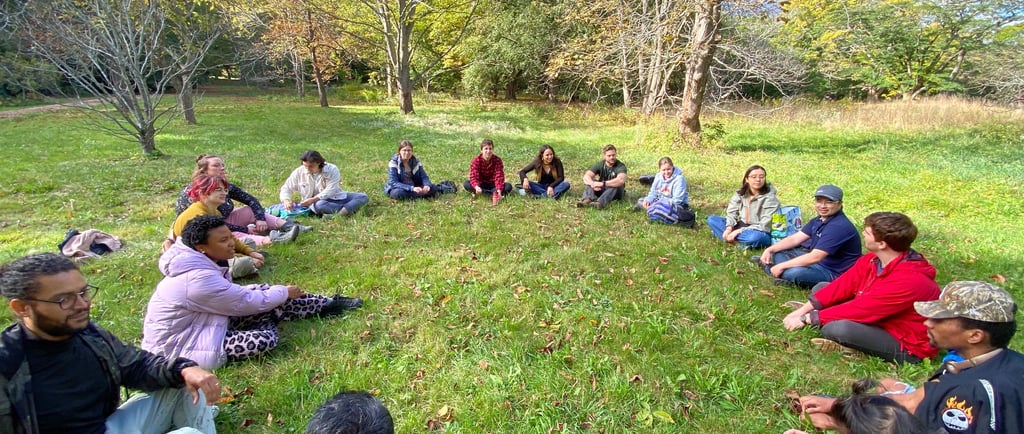
In this sense, progress on psychedelics will continue forward as long as there are people and communities where people can feel the courage to share their stories and learn. Creating these brave space will be the challenge of advocates who see the potential of plant medicines to help people heal.
Bay Staters for Creative Well-Being
Building healthful community through creative art and nature education
© 2026. All rights reserved. Bay Staters Incorporated, 501(c)3